

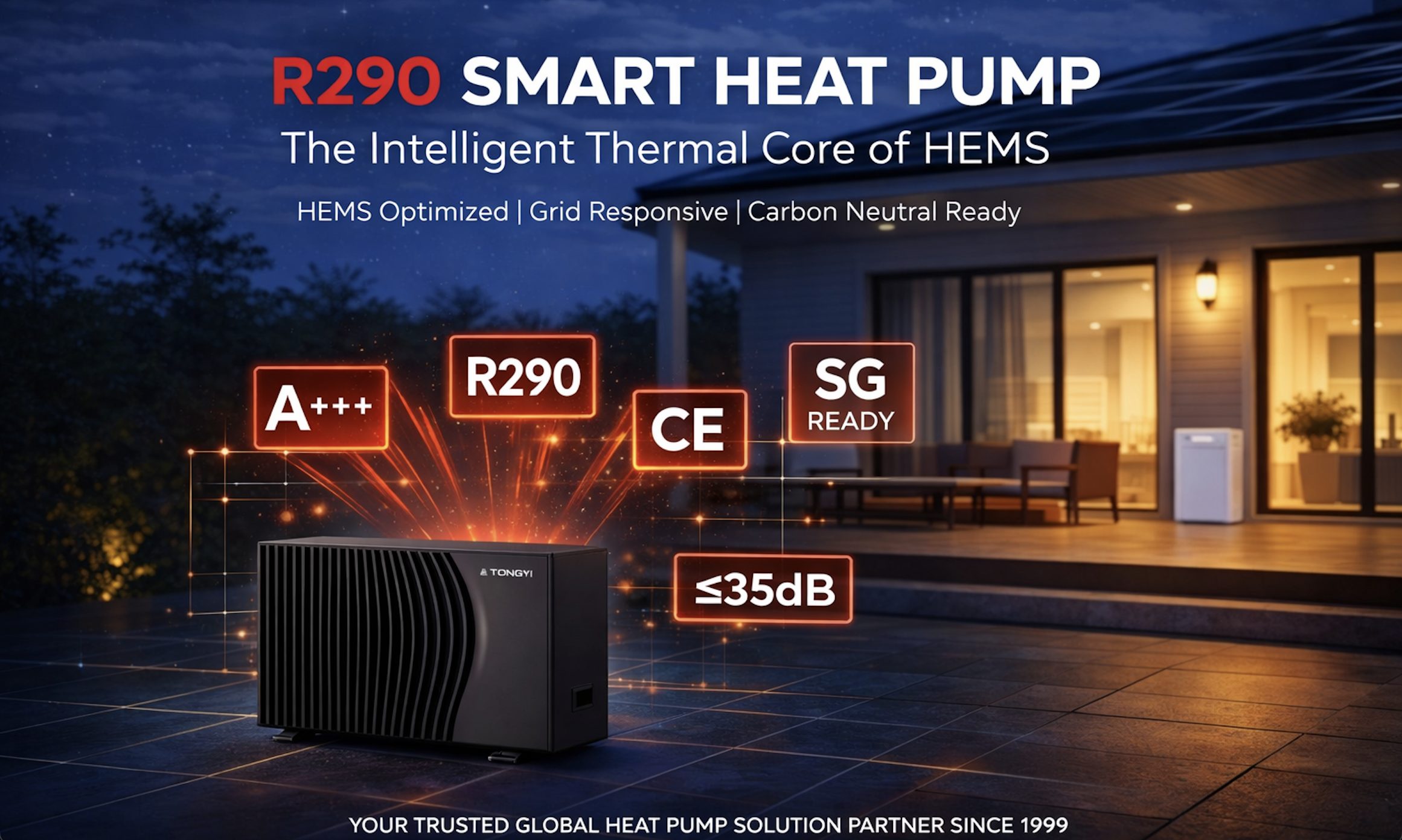
Why Heat Pumps Can No Longer Think Only in Temperatures
For many years, heat pump performance was assessed almost exclusively through thermodynamic indicators: COP values, flow temperatures, defrost behavior, and refrigerant selection. These parameters remain essential — particularly for high-performance R290 systems — but on their own, they no longer describe how a heat pump truly performs in today’s energy landscape.
The context around heating systems has evolved faster than the machines themselves. What increasingly differentiates modern systems is their ability to function as an energy-aware heat pump, combining high-efficiency R290 thermodynamics with intelligent control logic.
Modern heat pumps now operate within an environment shaped by energy price volatility, decentralized electricity generation, and increasing pressure on power grids. In this reality, a system that reacts only to temperature demand is no longer fully optimized.
Energy Volatility Is Now the Norm
Across Europe, electricity pricing is increasingly driven by short-term dynamics:
- Variable renewable generation
- Local grid congestion
- Time-dependent and dynamic tariffs
As a result, the cost of running a heat pump can change significantly within the same day. Systems built around static schedules or fixed control logic are effectively blind to these fluctuations.
Efficiency, in practical terms, is no longer defined only by how much energy a heat pump consumes — but when it consumes it.
Self-Consumption Is No Longer Optional
With residential photovoltaic systems now widespread across many European markets, homes are no longer passive energy users. They increasingly generate electricity locally, often producing more than their immediate demand.
Exporting surplus electricity back to the grid is becoming less attractive, both economically and structurally. Consequently, self-consumption has shifted from a “nice-to-have” feature to a system-level requirement.
From a system perspective, heat pumps are uniquely positioned to absorb excess on-site electricity and convert it into stored thermal energy. However, this potential can only be realized if the heat pump is capable of responding to energy availability, not just comfort demand.
Grid Pressure Is Redefining System Behavior
As electrification accelerates, distribution grids across Europe are under growing strain. In response, grid operators are already introducing mechanisms to manage peak loads and encourage more flexible consumption patterns.
Within this framework, heating systems are increasingly expected to function as adaptive assets, capable of:
- Shifting operation when energy is abundant
- Reducing load during peak grid stress
- Supporting grid stability rather than amplifying instability
This transition is structural, not temporary. Heat pumps that cannot adapt to these conditions risk becoming constraints instead of solutions.
Why Intelligence Is Now a Core Specification
R290 has established itself as a leading refrigerant for sustainable, high-performance heat pumps. However, refrigerant choice alone no longer defines system relevance.
What increasingly differentiates modern systems is their control architecture:
- Can the heat pump respond dynamically to energy availability?
- Can it prioritize self-consumption without external system complexity?
- Can it operate efficiently within evolving grid constraints?
In an energy-aware world, intelligence is no longer an optional add-on. It is a core specification, as fundamental as compressor technology or heat exchanger design.
The next generation of systems will be defined not only by efficiency, but by whether they are designed as an energy-aware heat pump — fully integrated into the energy ecosystem around them.
Looking Ahead
The next generation of heat pump systems will not be defined solely by how efficiently they produce heat, but by how intelligently they interact with the energy system around them. As energy volatility, self-consumption, and grid constraints become structural conditions, system design must evolve accordingly.
In the coming weeks, we will examine how this shift translates into concrete design choices, control strategies, and product evolution — and what it means in practical terms for installers, system designers, and end users.
This evolution is now materializing at product level. The optimized Tongyi R290 RH Series, developed from the ground up for energy-aware operation and advanced control logic, will be officially launched next Friday — marking a decisive step from energy-aware theory to deployable system reality.