
Introduction
At the SEAI Energy Show 2026 in Dublin, one message stood out clearly:
heat pumps are no longer standalone heating devices.
They are evolving into active energy nodes—intelligent systems that interact with solar generation, battery storage, and the grid.
This shift marks a fundamental transformation in how heating is designed, controlled, and integrated within modern energy systems.

What Is a Heat Pump Energy Node?
Traditionally, a heat pump operates as a demand-driven unit:
- It activates when heating is required
- It consumes electricity passively
- It has limited interaction with external energy systems
An energy node, by contrast, is fundamentally different.
It is a system that:
- Responds to real-time energy conditions
- Interacts with generation sources (PV)
- Coordinates with storage systems (batteries)
- Adapts operation based on grid signals or energy availability
In this model, heating becomes part of a broader energy ecosystem, not an isolated function.
From Device to System: What Is Changing?
The transition from device to energy node is driven by three converging factors:
1. Decentralized Energy Generation
With rooftop solar becoming standard, buildings are now producers of energy, not just consumers.
2. Storage Integration
Battery systems enable:
- load shifting
- self-consumption optimization
- reduced reliance on the grid
3. Intelligent Control Layers
Modern systems increasingly rely on:
- predictive control
- real-time data inputs
- system-wide coordination
Together, these elements redefine the role of the heat pump—from energy consumer to energy participant.
Real-World Implementation: System Integration in Practice
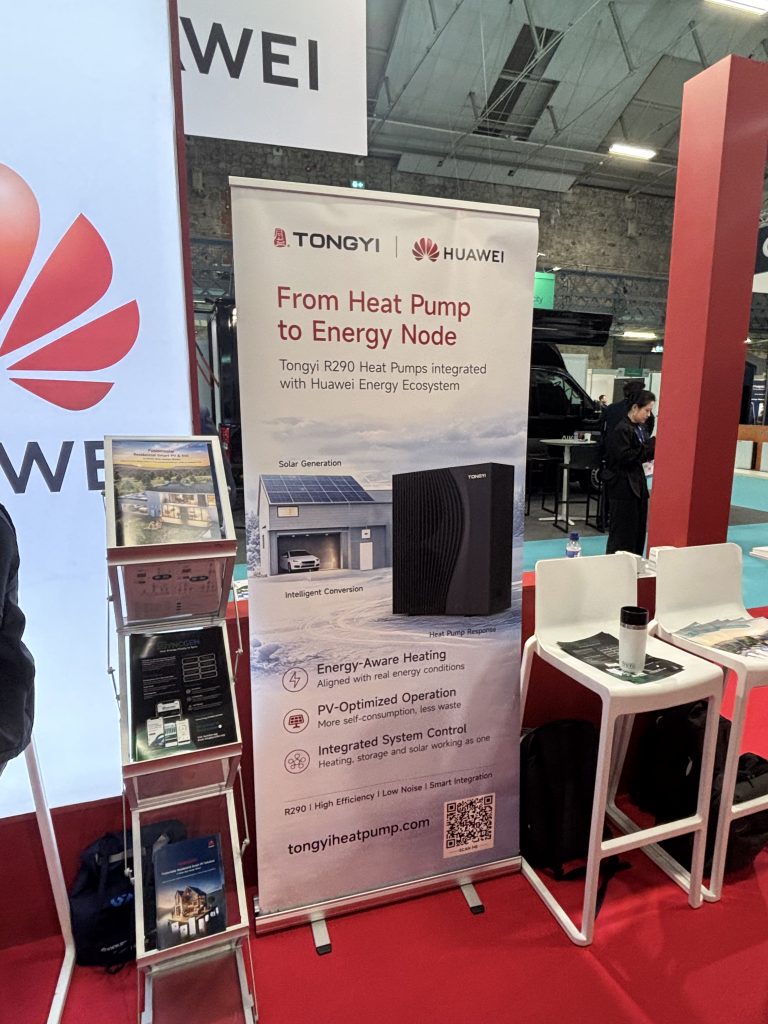
At the SEAI Energy Show 2026, this concept was not theoretical.
Tongyi demonstrated system compatibility within the Huawei energy ecosystem, showing how a heat pump can operate as part of an integrated setup including:
- Solar generation (PV)
- Inverter-based energy conversion
- Battery storage systems
- Centralized system control
This type of integration enables:
- Energy-aware heating
→ operation aligned with actual energy availability - PV-optimized performance
→ prioritizing self-consumption over grid dependency - System-level coordination
→ heating, storage, and solar working as a unified system
Importantly, this is not about adding features to a heat pump—it is about redefining its role within the system.
Why This Matters for the Market
This evolution has direct implications across the value chain:
For Installers
The role shifts from installing single units to designing integrated energy systems.
For Homeowners
Heating becomes a tool for:
- reducing energy costs
- increasing energy independence
- optimizing self-consumption
For the Grid
Flexible loads like heat pumps can:
- absorb excess renewable generation
- reduce peak demand
- contribute to overall system stability
Heating is no longer passive—it becomes strategic infrastructure.
Tongyi’s Positioning: System-Level Intelligence
Tongyi’s approach reflects this transition through:
- Energy-aware operation
- PV-responsive control logic
- Integrated system compatibility
Rather than focusing solely on unit-level efficiency, the emphasis is placed on:
making decisions before activation—based on the energy environment, not just thermal demand
This is the defining characteristic of an energy node.
Conclusion
The question for the industry is no longer:
How efficient is a heat pump?
But rather:
How intelligently does it interact with the energy system around it?
As demonstrated at the SEAI Energy Show 2026, the future of heating lies in integration, coordination, and system-level thinking.
The heat pump is no longer just a device.
It is becoming an energy node.