

The Grid Is Changing. Heating Must Change With It.
Europe’s power system is undergoing structural transformation. Renewable penetration is accelerating, electrification is intensifying peak demand, and grid constraints are becoming more visible. Price volatility and flexibility markets are no longer exceptional — they are systemic features of the modern energy landscape.
Heating systems can no longer remain passive electrical loads.
They must become active grid participants.
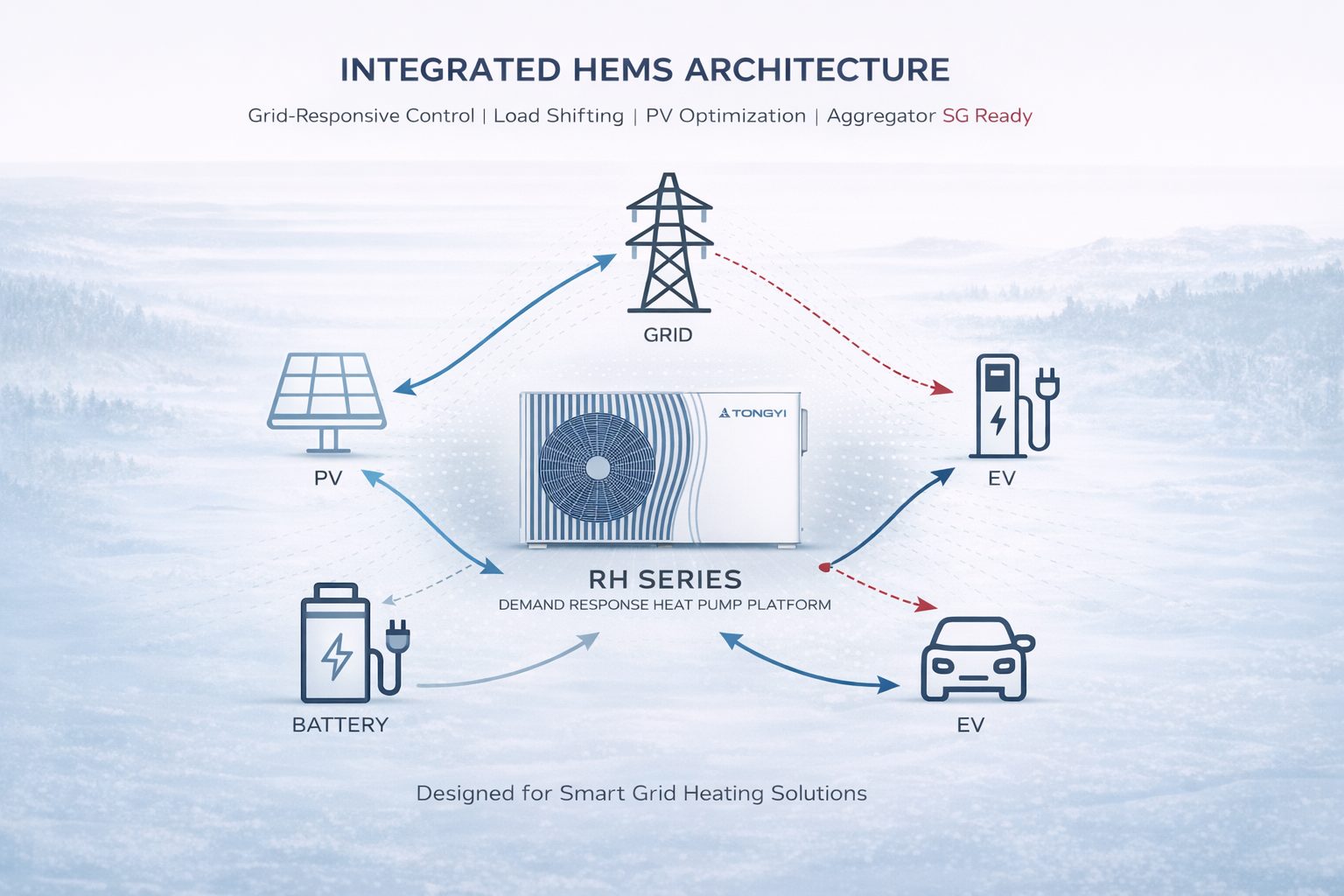
This is precisely the design philosophy behind the new Tongyi RH Series — engineered as grid-responsive heat pumps for the next generation of European energy systems.
What Is Grid-Responsive Heating?
Grid-responsive heating refers to heat pumps that can:
- Adjust power consumption based on external grid signals
- Respond to time-of-use tariffs
- Coordinate with PV production
- Integrate with aggregators and virtual power plants (VPPs)
- Provide demand-side flexibility
In engineering terms, this requires:
- Advanced inverter modulation
- Smart EMS/HEMS compatibility
- Load shifting capability
- Thermal storage logic
- External signal interface readiness
The Tongyi RH Series has been developed with this architecture in mind — not as an afterthought, but as a structural system feature.

Regulation-Ready by Design
Across the EU, flexibility frameworks are accelerating:
- Demand response programs
- Smart meter deployment
- Capacity remuneration mechanisms
- Dynamic electricity pricing
Future heat pumps must comply not only with Ecodesign and energy labelling requirements — but also with emerging smart grid interaction standards.
A regulation-ready unit must:
✔ Accept external control signals
✔ Operate efficiently at partial load
✔ Maintain COP performance during modulation
✔ Safeguard comfort under grid-controlled events
The Tongyi RH Series integrates adaptive inverter logic and structured communication layers designed to support grid interaction scenarios, reinforcing long-term regulatory alignment.
Aggregator-Ready: Turning Heating into a Grid Asset
Energy aggregators are becoming central actors in European electricity markets.
Heat pumps capable of:
- Temporary peak demand reduction
- Domestic hot water pre-heating during off-peak periods
- PV-prioritized operation
- Coordination with battery systems
… generate economic value beyond heating alone.
The RH Series supports this transformation by enabling structured load management strategies compatible with smart energy platforms.
Heating becomes not only a thermal appliance — but a flexibility resource within a distributed energy ecosystem.
Future-Proof Architecture
Future-proof heat pump engineering requires:
1. Communication Layer Integration
Native EMS compatibility and open control logic.
2. Thermal Buffer Utilization
Using DHW tanks and system inertia for intelligent load shifting without compromising comfort.
3. Software-Oriented Flexibility
Upgradeable control algorithms rather than hardware replacement.
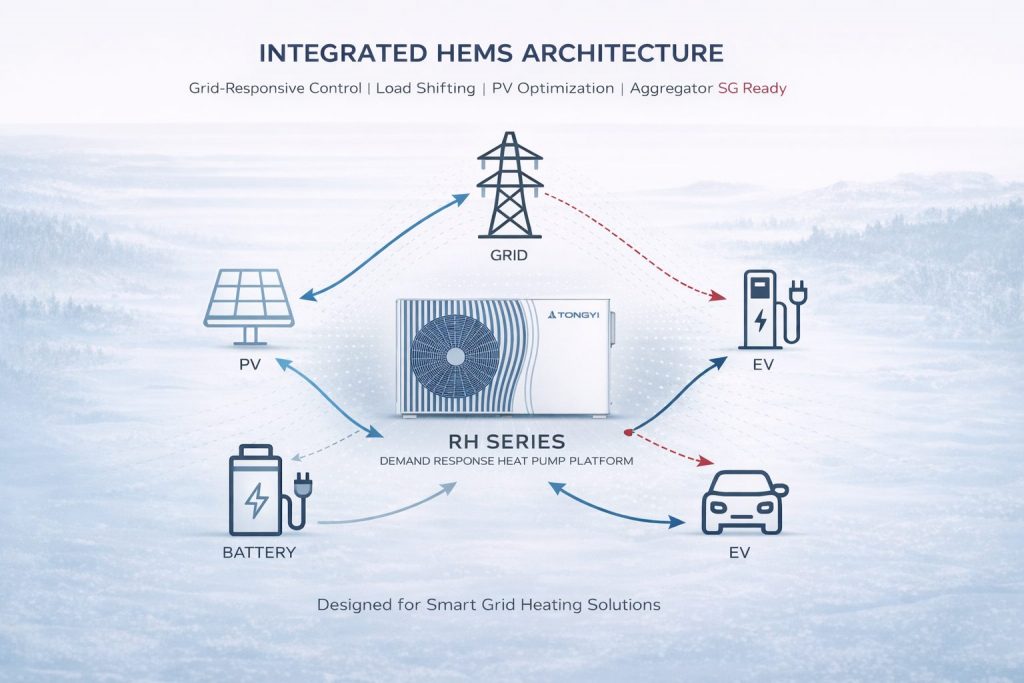
4. Hybrid & PV Coordination
Optimizing self-consumption while respecting grid constraints.
The Tongyi RH Series has been developed around this modular, intelligence-first architecture — aligning efficiency with system responsiveness.
Strategic Outlook
Grid-responsive heating is not a niche feature. It is a structural requirement of the next energy decade.
Manufacturers that anticipate this shift will:
- Align with EU decarbonization pathways
- Strengthen utility partnerships
- Increase product lifecycle value
- Position for flexibility-driven incentives
Efficiency remains fundamental.
But in the next energy decade, system value will increasingly be defined by timing, modulation, and grid interaction capability.
The Tongyi RH Series is designed accordingly.