

20 February 2026 — Updated June 2, 2026
The Grid Is Changing. Heating Must Change With It.
Europe’s power system is undergoing structural transformation. Renewable penetration is accelerating, electrification is intensifying peak demand, and grid constraints are becoming more visible. Price volatility and flexibility markets are no longer exceptional — they are systemic features of the modern energy landscape.
Heating systems can no longer remain passive electrical loads.
They must become active grid participants.
This is precisely the design philosophy behind the new Tongyi RH Series — engineered as grid-responsive heat pumps for the next generation of European energy systems.
What Is Grid-Responsive Heating?
Grid-responsive heating refers to heat pump systems that can be configured to:
- Adjust operation according to external energy-management signals
- Respond to dynamic or time-of-use tariff scenarios
- Coordinate heating operation with available solar PV generation
- Use domestic hot water or building thermal inertia for load-shifting strategies
- Operate as part of a wider residential energy-management architecture
In engineering terms, this may require:
- Efficient inverter modulation
- Smart EMS or HEMS compatibility
- Suitable external communication interfaces
- Thermal storage management
- Verified configuration with the selected energy-management ecosystem

Demand-Responsive Heating Through Smart Energy Integration
As European electricity systems integrate more renewable generation, heat pumps capable of operating within smart-energy environments are becoming increasingly relevant. In these systems, heating operation can be coordinated with energy-management controls, dynamic electricity signals and available onsite renewable energy.
The Tongyi RH Series is designed for energy-aware residential heating systems in which heat pump operation can be coordinated with external energy-management controls.
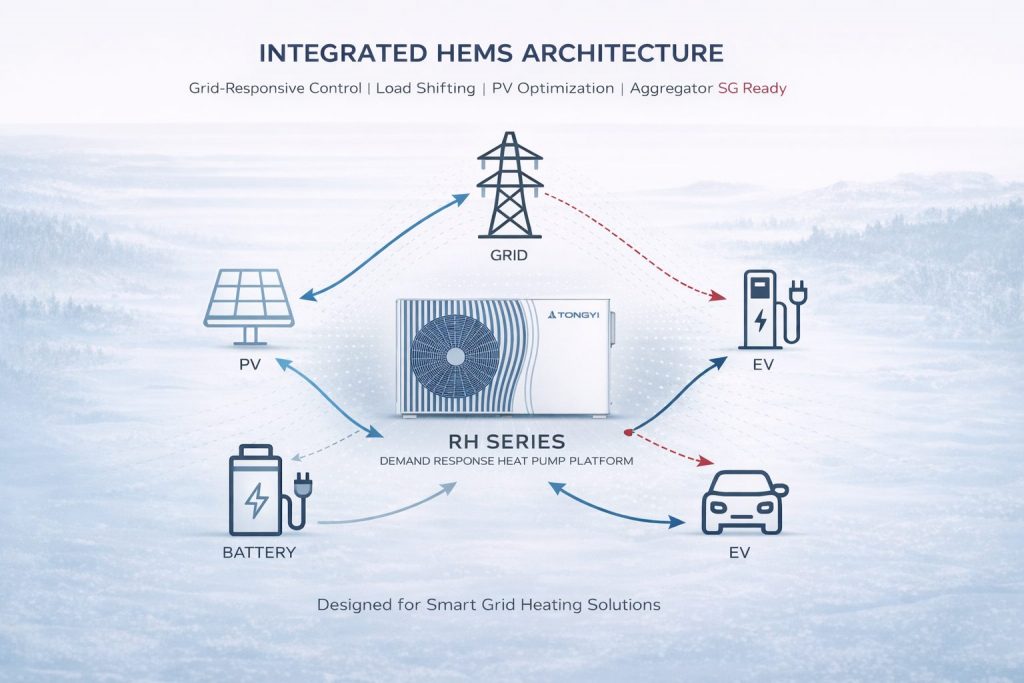
In a Huawei FusionSolar-based configuration, SmartAssistant acts as the coordination layer between the wider household energy system and the Tongyi heat pump. This enables the heat pump to be considered within operating scenarios involving solar PV generation, battery-system availability and managed electricity consumption.
Tongyi documentation identifies EEBUS and MODBUS communication capability, together with demand-response and PV-follow operating concepts. This supports the positioning of the RH Series as a heat pump designed for integration into smart-energy and load-shifting scenarios.
The exact functionality available in an installation depends on the selected SmartAssistant configuration, compatible Huawei inverter and battery components, communication setup and commissioning requirements. Specific smart-grid certification status and market-level demand-response participation should be confirmed separately for each target market and project.
PV, Battery Storage and Managed Heat Pump Operation
A smart-energy heating system can use available information from the wider residential energy ecosystem to improve when the heat pump operates.
For example, within a suitable configured system, heat pump operation may be coordinated with:
- Available solar PV generation
- Battery-system status
- Household energy-management priorities
- Planned domestic hot water heating periods
- Load-shifting strategies intended to reduce consumption during less favourable periods
In the Tongyi and Huawei integration architecture, this coordination is performed through SmartAssistant. The heat pump should therefore be presented as part of a managed energy system, rather than as a device that independently controls the inverter or battery storage system.
This architecture can support more intelligent use of renewable electricity for heating and domestic hot water, subject to the compatible equipment, system design and commissioning configuration used in the project.
Future-Proof Architecture
Future-proof heat pump engineering requires:
1. Communication Layer Integration
Native EMS compatibility and open control logic.
2. Thermal Buffer Utilization
Using DHW tanks and system inertia for intelligent load shifting without compromising comfort.
3. Software-Oriented Flexibility
Upgradeable control algorithms rather than hardware replacement.
4. Hybrid & PV Coordination
Optimizing self-consumption while respecting grid constraints.
The Tongyi RH Series has been developed around this modular, intelligence-first architecture — aligning efficiency with system responsiveness.
Strategic Outlook
Grid-responsive heating is not a niche feature. It is a structural requirement of the next energy decade.
Manufacturers that anticipate this shift will:
- Align with EU decarbonization pathways
- Strengthen utility partnerships
- Increase product lifecycle value
- Position for flexibility-driven incentives
Efficiency remains fundamental.
But in the next energy decade, system value will increasingly be defined by timing, modulation, and grid interaction capability.
The Tongyi RH Series is designed accordingly.