
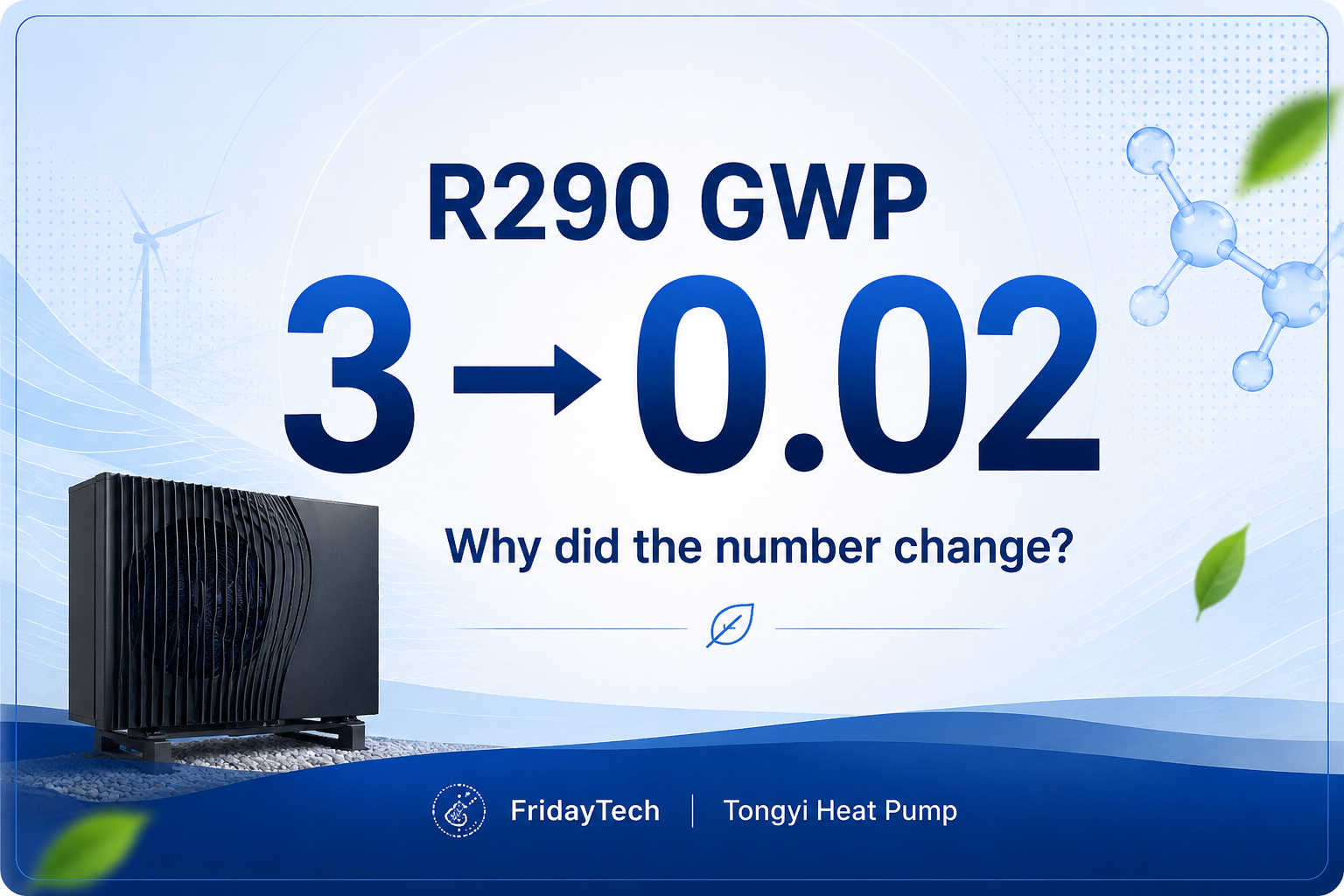
If you search for the GWP of R290, you may find two very different numbers: 3 and 0.02.
So, which one is correct?
The answer is simple. Both figures have appeared in official European references. However, they come from different regulatory frameworks.
The previous EU F-gas Regulation listed R290 with a GWP of 3. The current Regulation (EU) 2024/573 lists propane, or R290, with a GWP100 of 0.02.
This change is important. It also helps explain why R290 heat pumps are receiving so much attention in Europe.
What Does GWP Mean?
GWP stands for Global Warming Potential.
It measures how strongly a greenhouse gas can contribute to global warming compared with carbon dioxide.
Carbon dioxide is the reference gas.
Therefore, a refrigerant with a high GWP can have a greater climate impact if it escapes into the atmosphere. A refrigerant with a very low GWP has a much smaller direct climate impact.
For this reason, refrigerant choice has become an important issue for the heat pump industry.
What Is the GWP of R290?
R290 is the refrigerant name for propane.
Under the current European F-gas framework, R290 has a GWP100 of 0.02.
This is extremely low.
For comparison, R32 has a GWP of 675 under the same regulatory framework.
That difference is one reason why manufacturers are increasingly interested in R290 for air-to-water heat pumps.
However, GWP is not the only factor to consider.
R290 is classified as an A3 refrigerant. This means it is highly flammable. Therefore, heat pump systems using R290 must include the correct safety design, installation requirements and refrigerant management.

Why Do Some Documents Still Say R290 Has a GWP of 3?
You may still find heat pump brochures, technical documents and websites that state:
R290 GWP = 3
That does not necessarily mean the information was incorrect when it was published.
The previous EU Regulation 517/2014 listed propane with a GWP value of 3.
The newer Regulation (EU) 2024/573 now lists a value of 0.02.
Therefore, older documents may still use the previous figure.
This is also a useful reminder. When comparing refrigerant data, always check the source and the date of the information.
Why Is a Low GWP Important for Heat Pumps?
Europe is reducing the use of refrigerants with a high climate impact.
The revised EU F-gas Regulation introduces tighter rules for fluorinated greenhouse gases. These rules will affect many types of refrigeration, air-conditioning and heat pump equipment.
As a result, manufacturers are developing systems that use refrigerants with a much lower GWP.
R290 is particularly interesting because it is a natural refrigerant with an extremely low current GWP value.
Therefore, it can support the long-term transition toward lower-emission heating technologies.
Still, manufacturers must consider more than environmental performance.
A heat pump must also provide:
- high seasonal efficiency;
- reliable operation;
- safe refrigerant management;
- good acoustic performance;
- suitable operating temperatures;
- intelligent control;
- and stable performance in different climates.
The refrigerant is only one part of the complete system. For a detailed explanation of how outdoor temperature affects COP and heating capacity, read our guide to heat pump efficiency in cold weather.
Why Is R290 Suitable for Air-to-Water Heat Pumps?
R290 offers more than a low GWP.
Its thermodynamic properties make it well suited to modern air-to-water heat pump technology.
In particular, R290 systems can be designed for relatively high water temperatures. This makes the technology interesting for both new buildings and selected retrofit applications.
Tongyi develops R290 air-to-water heat pumps for residential heating, cooling and domestic hot water.
The current range includes models for different residential heating requirements. Depending on the model and operating conditions, water outlet temperatures can reach up to 75°C.
This gives R290 heat pumps potential in several applications, including:
- new residential buildings;
- home renovation projects;
- domestic hot water production;
- underfloor heating;
- fan-coil systems;
- and selected radiator-based heating systems.
R290 Is Part of a Wider Energy Transition
The transition to R290 is not simply about replacing one refrigerant with another.
A modern heat pump is becoming part of a much larger home energy system.
For example, a heat pump can work together with:
- photovoltaic panels;
- home battery storage;
- energy management systems;
- dynamic electricity tariffs;
- and smart-grid signals.
This allows the system to use electricity when conditions are more favorable.
Therefore, the future of heating is not only about producing heat efficiently. It is also about deciding when and how energy should be used.
Tongyi is developing its R290 heat pump technology with this wider energy environment in mind.
The RH Series, for example, is designed to support integration with home energy management systems. This allows the heat pump to work more closely with PV generation, batteries and electricity tariffs.
Is R290 a Future-Ready Refrigerant?
R290 has several characteristics that make it attractive for future heat pump development.
First, its current GWP is extremely low.
Second, it offers useful thermodynamic properties for air-to-water heat pumps.
Third, it supports the industry’s move away from high-GWP fluorinated refrigerants.
However, R290 also requires careful safety engineering because of its flammability.
For manufacturers, this means that good R290 technology depends on much more than simply selecting propane as the refrigerant.
The complete system must be designed, tested and manufactured correctly.
So, Is the R290 GWP 3 or 0.02?
Here is the simple answer:
Previous EU Regulation 517/2014: R290 GWP = 3
Current EU Regulation 2024/573: R290 GWP100 = 0.02
Therefore, 0.02 is the current value used in the latest EU regulatory framework.
The older value of 3 may still appear in existing technical documentation.
Understanding this difference is important when comparing heat pumps, refrigerants and product specifications.
It also shows how quickly the heat pump industry is evolving.
With an extremely low GWP and strong potential for high-temperature air-to-water applications, R290 is becoming one of the key refrigerants in the transition toward more sustainable heating.
#FridayTech | Tongyi Heat Pump
Considering R290 for your next heating project? Explore Tongyi’s R290 air-to-water heat pumps or contact our team for model-selection advice, technical specifications and a quotation.