
R32 vs R290 Air-to-Water Heat Pumps: Key Differences
Choosing between R32 vs R290 heat pumps requires more than comparing heating capacity. Refrigerant type can influence environmental impact, outlet-water temperature, system design, installation requirements and long-term market suitability.
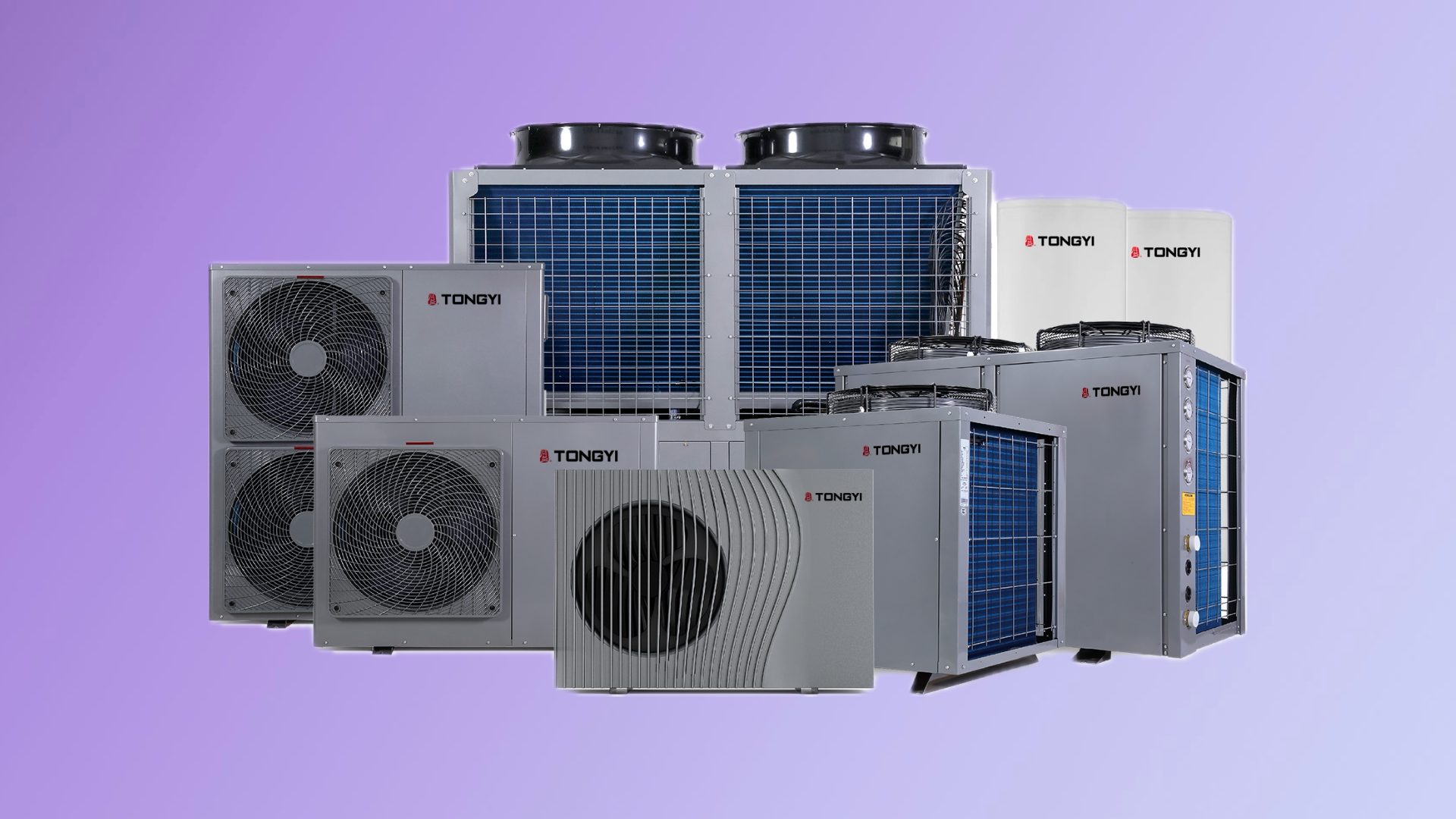
Tongyi offers air-to-water heat pump solutions using both refrigerants. This comparison explains their principal characteristics to help homeowners, installers and distributors choose the right system for each project.
What Are R32 and R290 Refrigerants?
R32 is a synthetic refrigerant widely used in modern heating and cooling systems. It offers good thermodynamic performance and has a Global Warming Potential (GWP) of approximately 675. R32 is classified as an A2L refrigerant, meaning it has lower toxicity and lower flammability.
R290, also known as propane, is a natural refrigerant with a GWP of approximately 3. Its extremely low climate impact makes it an increasingly important option as Europe moves towards lower-GWP heating technologies. R290 is classified as A3, meaning it has lower toxicity but high flammability. Heat pumps using R290 must therefore be designed and installed according to the applicable safety requirements.
R32 Air-to-Water Heat Pumps
Tongyi’s R32 air-to-water heat pumps combine DC inverter operation with Enhanced Vapour Injection technology. EVI supports stable heating performance in low outdoor temperatures, making these systems suitable for cold-climate applications.
Depending on the model and operating conditions, Tongyi R32 heat pumps can produce outlet water at temperatures of up to 60°C. This makes them suitable for:
- Underfloor heating
- Low- and medium-temperature radiators
- Fan-coil systems
- Domestic hot water production
- Residential heating and cooling
R32 heat pumps offer proven technology, efficient performance and broad market availability. They can be a practical choice for projects where a maximum water temperature of approximately 60°C is sufficient.
R290 Air-to-Water Heat Pumps
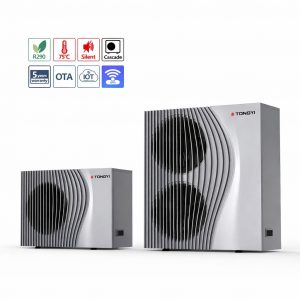
Tongyi’s R290 air-to-water heat pumps are designed to combine high efficiency with a significantly lower refrigerant GWP. Selected models can produce outlet water at temperatures of up to 75°C, providing greater flexibility for domestic hot water and renovation projects with higher-temperature heating systems.
Depending on the model and test conditions, Tongyi R290 heat pumps can achieve a COP above 5.0 and an EER above 3.8. Their principal benefits include:
- Natural refrigerant with a very low GWP
- Outlet-water temperatures of up to 75°C
- Efficient heating, cooling and domestic hot water
- Quiet operation
- Smart control and IoT connectivity
- Compatibility with solar PV and energy-management systems
- Suitability for new buildings and heating-system renovations
The higher available water temperature can make an R290 heat pump particularly useful when replacing a conventional boiler. However, proper system sizing and an assessment of the existing radiators, insulation and heat demand remain essential.
 Select options This product has multiple variants. The options may be chosen on the product page Quick View
- Select options This product has multiple variants. The options may be chosen on the product page Quick View
R32 vs R290 Heat Pumps: Comparison
| Feature | R32 heat pump | R290 heat pump |
|---|---|---|
| Refrigerant type | Synthetic | Natural propane |
| Approximate GWP | 675 | 3 |
| Safety classification | A2L | A3 |
| Flammability | Lower flammability | Highly flammable |
| Maximum outlet water temperature* | Up to 60°C | Up to 75°C |
| Cold-climate operation | Supported by EVI technology | Designed for low-temperature operation |
| Typical applications | New builds and low-temperature systems | New builds, renovations and higher-temperature systems |
| Environmental impact from leakage | Higher than R290 | Significantly lower than R32 |
*Maximum temperatures and performance values depend on the specific model, outdoor temperature, water-flow conditions and system configuration.
Which Refrigerant Is More Sustainable?
When comparing the refrigerants alone, R290 has a clear environmental advantage because its GWP is substantially lower than that of R32. This reduces the potential climate impact if refrigerant leakage occurs.
However, a heat pump’s overall environmental performance also depends on seasonal efficiency, electricity source, system sizing, installation quality and operating temperature. Even a highly efficient unit can consume more electricity than expected if it is incorrectly sized or connected to an unsuitable heating system.
For the best results, refrigerant choice should form part of a complete system assessment rather than being treated as the only selection criterion.
Safety and Installation Requirements
Both R32 and R290 require appropriate handling and installation procedures.
R32 is classified as A2L and therefore has lower flammability. R290 is classified as A3 and requires additional attention to safety distances, unit placement, ignition sources and refrigerant-specific installation instructions.
Many R290 air-to-water heat pumps use a monobloc design, keeping the complete refrigerant circuit inside the outdoor unit. This simplifies the hydraulic connection to the building, but installers must still follow the manufacturer’s instructions and all applicable national and European safety requirements.
Smart Control and System Integration
Tongyi R32 and R290 heat pumps offer control functions designed to support comfort and efficient operation. Depending on the selected model and configuration, these may include:
- Remote monitoring
- Wi-Fi and IoT connectivity
- Heating and cooling control
- Domestic hot water scheduling
- Two-zone temperature management
- Cascade operation
- Integration with solar PV and energy-management systems
Smart control can help align heat pump operation with household demand, available renewable electricity or lower-cost energy periods.
R32 or R290: Which Heat Pump Should You Choose?
An R32 heat pump may be suitable when proven technology, efficient low-temperature heating and broad installation familiarity are the main priorities.
An R290 heat pump may be the better choice when the project requires:
- A refrigerant with an ultra-low GWP
- Higher outlet-water temperatures
- Greater compatibility with existing radiators
- A future-oriented heating solution
- Integration with renewable electricity and smart energy systems
The final decision should consider the building’s heat loss, required water temperature, climate, domestic hot water demand, installation location and local regulations.
Tongyi R32 and R290 Heat Pump Solutions
The R32 vs R290 heat pumps comparison shows that both technologies can deliver efficient heating, cooling and domestic hot water. R32 remains a capable and established option, while R290 provides a lower-GWP solution with higher available water temperatures.
Tongyi supports distributors, installers and OEM partners with a range of air-to-water heat pumps for different climates, buildings and market requirements. Contact our team to compare models and identify the most suitable solution for your project.