


Water beneath an air-source heat pump is not automatically a leak.
During heating operation, moisture in the outdoor air can condense and freeze on the outdoor heat exchanger. The heat pump periodically defrosts the coil, and the melted water must then leave the unit safely.
That makes heat pump condensate drainage a normal part of outdoor-unit design—not an optional finishing detail.
If the water is allowed to collect under the unit, it can refreeze, obstruct drainage, create a slip hazard or build up around the base and fan area. A suitable drain or soakaway, designed for local winter conditions and the specific heat-pump model, helps prevent these problems.
This guide explains where the water comes from, what good drainage needs to achieve, how to reduce winter ice risk and when water beneath a heat pump needs professional investigation.
Why does an air-source heat pump produce water?
In heating mode, an air-source heat pump extracts energy from outdoor air. The outdoor heat exchanger operates at a temperature below the surrounding air, so water vapour can condense on its surface.
When the coil temperature is below freezing, that moisture can form frost or ice. The controller then initiates a defrost cycle when required. Depending on the heat-pump design, the refrigeration cycle may temporarily reverse or another approved defrost method may be used to warm the outdoor coil.
The melted frost becomes defrost water. It falls into or through the base of the outdoor unit and must be collected or directed to a suitable discharge point.
The amount is not constant. It changes with:
- outdoor temperature;
- relative humidity;
- heating demand and compressor operation;
- defrost frequency and duration;
- coil and base design;
- the installation’s exposure to rain, snow and wind.
Cold, damp weather can therefore produce more visible water than a dry day at the same temperature. Water appearing during or shortly after defrost can be normal; the quality of the drainage route determines whether it becomes a problem.
Condensate water and a heating-system leak are not the same
It is important to distinguish normal defrost water from water escaping from the hydraulic circuit.
Normal condensate or defrost water usually:
- appears at the outdoor coil or base;
- varies with the weather and operating cycle;
- is most noticeable during or after defrost;
- does not by itself cause the sealed heating circuit to lose pressure.
A possible hydraulic leak may be associated with:
- a falling system-pressure reading;
- water at a pipe connection, valve or internal component;
- inhibitor-coloured, dirty or glycol-containing fluid;
- repeated need to repressurise the heating circuit;
- an alarm or loss of heating performance.
Do not taste or handle unknown fluid to identify it. If the source is unclear. If you’re unsure where the water is coming from, keep people clear of the area and contact a qualified technician. Follow the manufacturer’s safety instructions. Isolate the area from pedestrians and ask a qualified technician to inspect it.
Where should heat pump condensate drain?
The route must be designed around the heat-pump manufacturer’s instructions, the site and local requirements.
As a useful benchmark, the UK MCS heat-pump installation standard states that condensate from an air-source heat pump must discharge safely to a suitable drain or soakaway. Ireland’s SEAI heat-pump technical bulletin similarly identifies surface discharge beneath the unit without drain access as non-compliant practice.
These are UK- and Ireland-oriented references, not universal building rules. The exact solution must comply with the product documentation and regulations that apply at the installation location.
A suitable route normally needs to:
- accept the expected water under local cold and humid conditions;
- direct water away from the unit and building;
- prevent water from crossing paths, steps or access routes;
- avoid uncontrolled discharge onto a neighbour’s property;
- protect foundations and finishes from persistent wetting;
- remain accessible for inspection and cleaning;
- resist blockage by leaves, silt, snow and ice;
- avoid compromising any refrigerant safety area.
The discharge point might be a correctly designed soakaway, a suitable surface-water drainage connection or another method permitted by the product instructions and local rules. It should not be improvised after the outdoor unit has already been positioned.
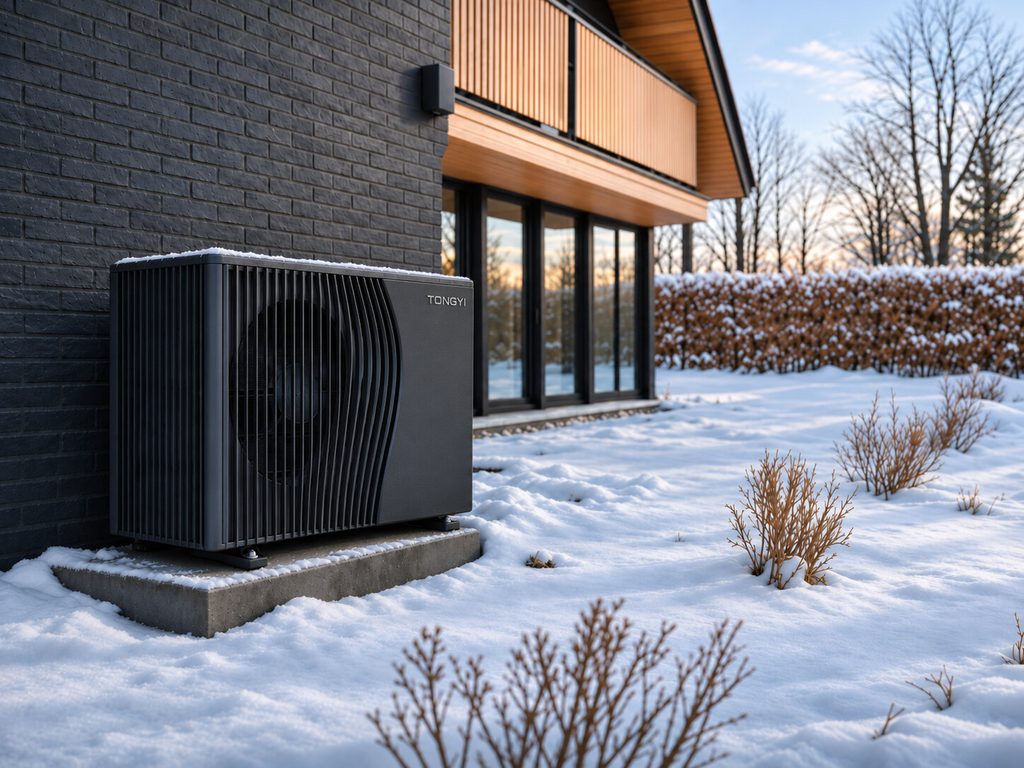
Why winter drainage needs special attention
Defrost water leaves the coil in the very conditions that can make it freeze again.
Cold discharge air can reduce the temperature around the heat pump. If the unit sits in a confined location with poor air movement, the site can develop a localised cold zone. Water that pools beneath the base or remains in a flat drain section may then freeze.
The SEAI Heat Pumps Technology Guide advises that condensate drainage design must account for freezing caused by the heat pump’s own cold air and that adequate space can help avoid a localised “cold well.”
This is one reason the outdoor unit should be sited as a complete system rather than treated as a box that can fit into any remaining space.
Seven principles for reliable heat pump condensate drainage
1. Start with the exact installation manual
Check the model’s required base, drain openings, connection method, clearances and winter accessories before constructing the foundation.
Some heat pumps allow water to drain freely through several base openings. Others use a drain pan, drain socket or approved collection kit. Blocking openings or forcing all water through an unsuitable connection can create ice where the manufacturer intended free drainage.
Do not assume that a detail used on another brand or model applies to the current unit.
2. Provide a stable, level and adequately raised base
The base must support the equipment, maintain the specified orientation and leave enough space for drainage and service access.
In snowy or icy regions, the specified stand or plinth may need to raise the unit above the anticipated accumulation level. The exact height is project- and climate-specific; use the manufacturer’s requirements and local design conditions rather than a universal online dimension.
A level support does not mean the drainage route itself should be flat. The unit must stand as specified, while the drain is arranged with the required fall.
Tongyi’s heat-pump installation checklist covers the wider siting, base, clearance and commissioning checks that must accompany the drainage design.
3. Use a short, direct route with continuous fall where specified
Water should not have to travel through unnecessary bends, long exposed sections or low points where it can remain after a defrost cycle.
A continuous fall helps empty the pipe, but the required slope, diameter and connection depend on expected flow, pipe length, fittings and the manufacturer’s design. There is no single pipe size or gradient suitable for every heat pump.
The installer should confirm that the whole route—not just the visible section beside the unit—can drain under the design conditions.
4. Protect the route from freezing
Where a piped drain is used, exposed sections may need frost protection. Depending on the approved design, that can involve routing within a frost-protected zone, minimising exposed length or using manufacturer-specified insulation or trace heating.
Trace heating should not be added casually. It must be suitable for the pipe material and environment, controlled correctly, electrically protected and installed according to the heat-pump and heater manufacturers’ instructions.
Insulation alone does not generate heat. It can slow heat loss, but it cannot guarantee that stationary water will remain unfrozen during prolonged cold weather.
5. Keep the outlet open and serviceable
A drain can work correctly at commissioning and fail later because the outlet becomes buried in leaves, mud, gravel, vegetation, snow or ice.
The route should be inspectable without dismantling the heat pump. The handover information should show the owner where the outlet or soakaway is and what visual checks are safe to perform.
Do not position the final outlet where normal gardening, resurfacing or snow clearance is likely to block it.
6. Prevent water from returning toward the unit
Surface levels around the foundation should direct rain and meltwater away from the heat pump. The outdoor unit should not sit in a depression that collects runoff from a roof, slope or paved area.
A soakaway must have suitable capacity and ground conditions. If the surrounding soil is saturated or impermeable, simply placing gravel under the heat pump may not provide effective drainage.
Site drainage, frost depth, groundwater and foundation protection may require input from the building designer or drainage specialist.
7. Test drainage during commissioning
The installer should inspect all base openings, connections, falls and discharge points and confirm that water can leave the installation safely.
The check should also include:
- clearance under and around the unit;
- support and joint integrity;
- possible ice or slip zones;
- service access;
- the effect of nearby walls and enclosures on cold-air recirculation;
- any approved drain-pan heater or trace-heating controls;
- compatibility with the R290 safety-area assessment where applicable.
A dry-weather commissioning visit cannot reproduce every winter condition, so the owner should also know what to observe during the first cold, humid period.
Should the drain pipe be insulated?
Sometimes, but insulation is not a universal cure.
Insulation may be part of an approved frost-protection design for a piped drain. Its effectiveness depends on pipe contents, exposure, length, ambient temperature and whether water remains trapped.
Do not confuse the condensate drain with the heating-system flow and return pipes. The hydraulic pipes carry system water and have separate insulation, weatherproofing and freeze-protection requirements. Tongyi’s guide to heat-pump pipe insulation explains that part of the installation in detail.
If a condensate route repeatedly freezes, adding more insulation without correcting poor fall, standing water or an unsuitable outlet may only hide the cause.
Is a heat pump condensate soakaway always suitable?
No.
A soakaway can be effective when it is correctly sized, positioned and protected from frost, and when the ground can accept the water. Suitability depends on:
- soil permeability;
- groundwater level;
- frost conditions;
- water volume and peak defrost discharge;
- distance from the building and foundations;
- nearby services and property boundaries;
- local drainage rules;
- product-specific R290 safety requirements.
A small hole filled with stones is not automatically an engineered soakaway. Poor soil or frozen ground can cause water to back up toward the heat pump.
Where infiltration is unsuitable, the designer should select another permitted route.
What does R290 change about drainage design?
R290 is propane refrigerant. It does not make defrost water hazardous in normal operation, and condensate drainage remains separate from the sealed refrigerant circuit.
However, the location and route of drainage can interact with the installation’s refrigerant safety assessment.
Manufacturer-defined safety areas may restrict openings, drains, pits, ducts or other low-level spaces near the outdoor unit because leaked refrigerant could migrate or collect there. The exact restrictions depend on refrigerant charge, unit design, installation geometry, applicable standards and the manufacturer’s instructions.
Therefore:
- do not assume that every drain is prohibited;
- do not assume that any convenient drain is acceptable;
- assess the proposed route against the exact model’s safety-area drawing;
- follow local rules and use trained personnel for installation and service.
Tongyi’s guide to R290 heat-pump safety explains why clearances, openings and low-level spaces must be evaluated for the specific installation.
For a Tongyi project, confirm the approved drainage arrangement for the selected model within the complete R290 inverter air-to-water heat-pump system design.
Is ice on an outdoor heat pump normal?
A temporary layer of frost on the outdoor coil can be normal in cold, humid weather. A correctly functioning defrost cycle should remove it when the controller determines that defrost is required.
Some water and short-lived ice near the drainage path may also be visible in freezing conditions. That is different from persistent accumulation that blocks the base, interferes with the fan, deforms components or creates an expanding slab around the unit.
Investigate when:
- ice continues to build through repeated operating cycles;
- the fan or coil is obstructed;
- defrost does not appear to complete;
- water backs up into the unit;
- the drain pan or outlet remains frozen;
- the unit reports an alarm;
- heating performance or water flow deteriorates;
- ice creates a hazard around the installation.
Do not diagnose defrost performance from one photograph alone. Outdoor temperature, humidity, operating mode, controller data and the timing within the cycle all matter.
Tongyi’s guide to heat-pump efficiency in cold weather provides the broader context for winter capacity, defrost and system design.
What should a homeowner check in winter?
Only perform checks that can be completed safely from outside the equipment.
Check the discharge area
Confirm that water is reaching the intended outlet and not crossing a walkway or collecting against the building.
Look under and around the base
Check for increasing ice that could obstruct the designed drain openings or reach the fan area.
Remove loose surface debris safely
Leaves or wind-blown material around the accessible outlet can often be removed without opening the unit. Keep hands and tools away from the fan, coil, electrical compartment and refrigerant components.
Keep snow clearance within the manufacturer’s guidance
Do not bury the air inlet, outlet or drain route while clearing the surrounding area. Avoid piling snow where meltwater will return toward the unit.
Review alarms and system pressure
An alarm, pressure loss or unexpected performance change may indicate more than a blocked condensate outlet.
Call the installer when ice keeps returning
Repeated blockage may point to an unsuitable route, failed heater, damaged component, commissioning problem or defrost fault. It requires diagnosis, not repeated temporary melting.
What should you not do to remove ice?
Do not:
- strike or chip the coil, base or drain pan with sharp tools;
- pour boiling water onto the heat pump;
- use an open flame or uncontrolled heat gun;
- add salt or de-icing chemicals unless specifically approved;
- block drain openings to redirect water;
- modify the base or drill the casing;
- reach through the grille or remove panels;
- cut electrical power as a routine response without checking the instructions.
These actions can damage coatings, plastic parts, sensors, wiring, the coil or the drainage system. Removing visible ice without correcting the cause may also allow it to return during the next defrost cycle.
If the installation is unsafe, keep people away and contact the installer or service provider.
Heat pump condensate drainage checklist
Use this checklist during design, installation and handover:
- The exact model’s installation manual has been reviewed.
- The base and stand provide the specified support, orientation and clearance.
- All intended base openings or drain connections remain unobstructed.
- Water discharges safely to a permitted drain, soakaway or approved alternative.
- The route has the specified fall and no unintended low points.
- Exposed pipework has an approved frost-protection strategy where required.
- The outlet is accessible for inspection and cannot easily be buried by debris or snow.
- Water cannot cross paths, damage the building or flow to neighbouring property.
- Site levels prevent rain and meltwater from returning toward the unit.
- Nearby walls or enclosures do not create prohibited clearance or cold-air recirculation issues.
- For R290 equipment, the route is compatible with the exact safety-area requirements.
- The drainage arrangement has been checked during commissioning and explained at handover.
Frequently asked questions
Is water dripping from an air-source heat pump normal?
It can be. Moisture condenses and may freeze on the outdoor coil during heating, then melts during defrost. Water at the designed drainage point can therefore be normal. Water at pipe joints, falling system pressure or unexplained continuous leakage needs investigation.
How much condensate does a heat pump produce?
There is no reliable universal figure. The amount varies with humidity, temperature, heating demand, defrost operation, model and exposure to precipitation. Drainage should be designed from manufacturer data and local conditions rather than a generic litres-per-day estimate.
Can heat pump condensate drain onto the ground?
Uncontrolled surface discharge beneath the unit may refreeze or create a hazard and may not comply with applicable standards. Use the route specified by the manufacturer and permitted locally, normally a suitable drain, soakaway or approved alternative.
Why is there a block of ice beneath my heat pump?
The drainage route may be blocked, flat, undersized, exposed to freezing or unable to absorb the defrost water. Site levels and cold-air recirculation may also contribute. Persistent accumulation should be assessed by the installer.
Does a heat-pump drain need a heater?
Not always. Some installations or models use an approved pan heater or trace-heating arrangement; others drain freely without one. Any heater must be specified, controlled and electrically protected for the exact application.
Can I pour hot water over a frozen heat-pump drain?
Do not use boiling water or uncontrolled heat. Thermal shock and water entering unintended areas can damage the equipment or create more ice. Follow the manufacturer instructions and contact the installer if the route remains blocked.
Is condensate from an R290 heat pump flammable?
No. Normal condensate is water from outdoor air, not refrigerant. R290 remains inside the sealed refrigeration circuit. Nevertheless, the drainage route and nearby low-level spaces must be considered in the model-specific refrigerant safety assessment.
Design the drainage before winter exposes the weakness
Condensate drainage is a small part of a heat-pump project with a large practical effect.
The outdoor unit can produce water whenever moisture condenses on the cold coil and melts during defrost. That water needs a safe route away from the equipment, building and access areas. The route must remain usable in freezing conditions, be inspectable and comply with the product instructions and local requirements.
For R290 equipment, drainage must also fit the model-specific safety-area assessment. That calls for qualified design—not a generic rule copied from another installation.
A stable base, suitable drain or soakaway, frost-aware routing and proper commissioning reduce the risk that ordinary defrost water becomes a winter ice problem.
For equipment selection and project-specific installation information, explore Tongyi’s R290 inverter air-to-water heat-pump range.